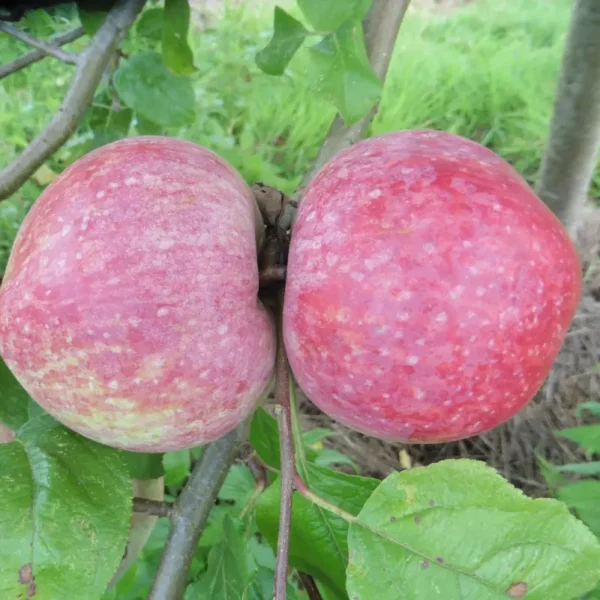
Few people know that Newport has its own apples thanks to the cultivation work of a man called John Basham of Bassaleg in the early part of the twentieth century. There are two principal varieties – Brith Mawr and St Cecilia.
Brith Mawr
Mid-season versatile apple (Big and Spotty), sharp eater from Newport, South Wales, can also be juiced and cooks to a puree. Large fruit with red patches. Prolific cropper. Harvest in September. Pollination group 3
Its name translates from Welsh as “large and speckled” or “speckled big,” describing its distinct yellow-green skin with red flecks and a dappled red blush.
History and Rediscovery
- First Record: Formally exhibited in 1934 by John Basham of Fairoak Nurseries in Bassaleg at the Royal Horticultural Society (RHS) Apples and Pears Conference.
- Disappearance: After the 1934 exhibition, the variety vanished from active horticultural records for decades.
- Rediscovery: Found growing in a garden near Cardiff and identified by the former manager of Fairoak Nurseries, allowing the rare variety to be preserved and reintroduced.
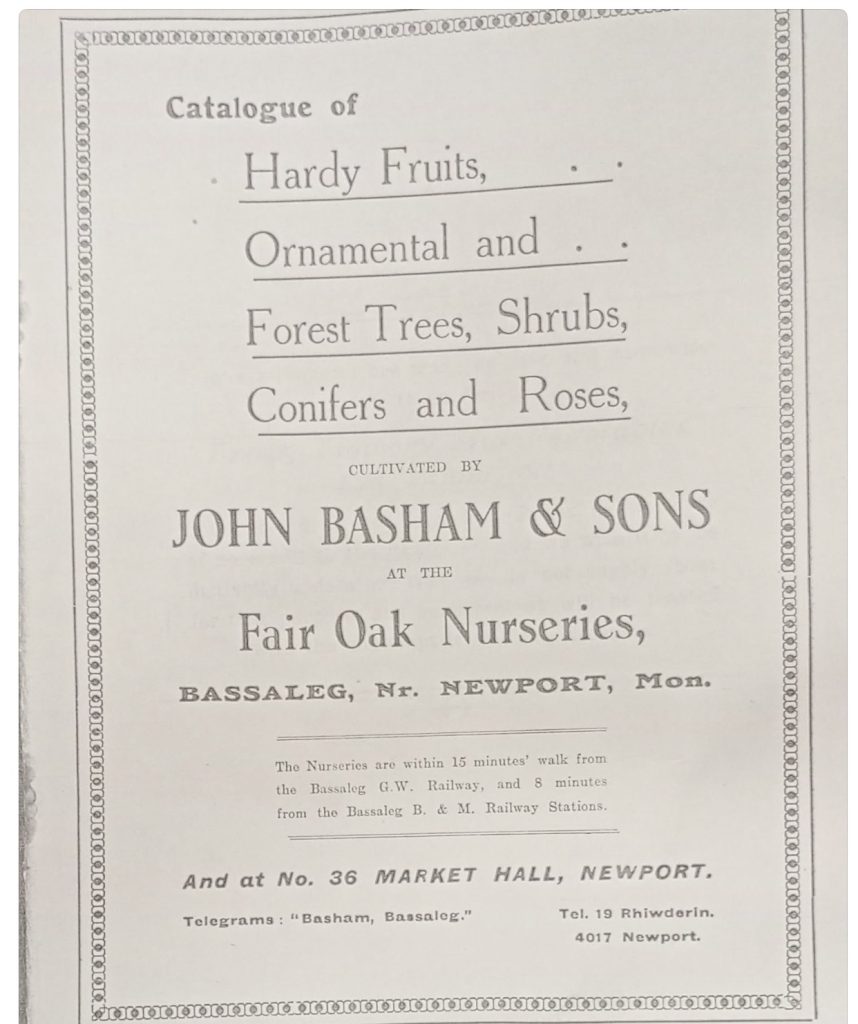
Fairoak Nurseries, Bassaleg were founded by John Basham (1845-1927) when he took over the house and lands at Fairoak in 1878. He was the senior partner of John Basham and Sons, with his sons, Henry and Joseph. For his great skill in rose and fruit growing he was made a Fellow of the Royal Horticultural Society. In 1899, he published in the Society’s journal an account of the state of fruit cultivation throughout Monmouthshire. He advocated the replanting of many orchards and with the aid of the new County Council’s Technical Committee which furnished farmers with instruction and small grants, the Fairoak Nurseries were able to provide many of the new fruit trees.
St. Cecilia
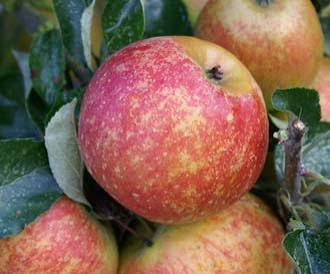
Named after the Welsh patron saint of music this is a mid-season eating apple from Bassaleg, Newport. Reportedly first cultivated by John Basham & Sons of Bassaleg in Monmouthshire in 1900 from a Cox seedling. A sweet juicy apple with an exquisite perfumed aroma is said to be at its best on St. Cecilia’s day (November 22nd). (Pollination group B)
Welsh apple cultivars have rarely been used for commercial purposes, with rare examples including Morgan Sweet or St Cecilia apples (with commercial-scale orchards mostly found in Monmouthshire). This is potentially due to the lack of selection for apples to serve one function, eating or cooking, thus reflecting their farm and smallholding cultivation history in Wales.
Cider apples
Cider apple trees are a common site on the Levels. The sour fruit was a key part of agricultural production in local villages, common varieties include
- Breakwell’s Seedling: A 19th-century bittersweet/sharp seedling originating from Perthyre, Monmouthshire, prized for fragrant and fruity single-variety craft juices.
- Frederick: A pure sharp cider apple variety native to Monmouthshire.
- Gwell Na Mil & Afal Anghidi: Rare regional heritage cider apple cultivars tied historically to Monmouthshire orchards.
Some of the orchards have disappeared but groups like the Gwent Wildlife Trust and the Welsh Perry and Cider Society have mapped remaining sites,DNA-tested ancient trees, and worked to safeguard rare local fruit strains.
Detailed OS maps from 1888 -1913 show us that most farms and small holdings had an orchard, some larger than others, and that overall this area produced a significant amount of fruit, comparable to that of the Somerset Levels and Herefordshire.
From historical accounts and records, such as wills, censuses, bills of sales and parish records, we can ascertain the importance of this crop. Much of the fruit was turned into cider and was used as part payment for migrant agricultural workers (the ‘truck system’). A general rule seems to have been: the better-quality cider produced, the better quality of worker attracted!
There has also been a planned programme of replanting with local varieties obtained from the Welsh Cider and Perry Association. So far, 174 trees have been planted at 29 orchards across the Levels.