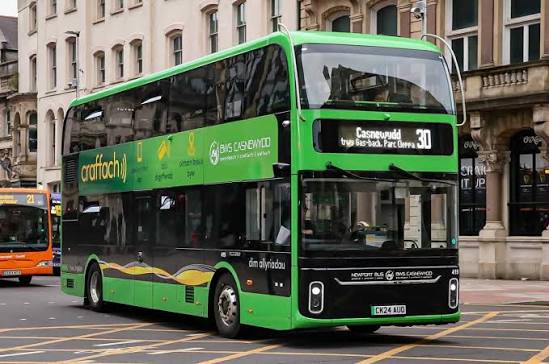
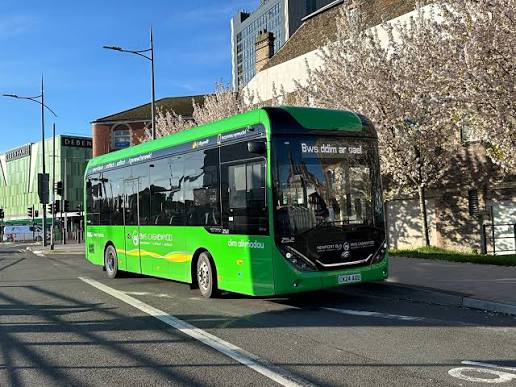
Sometimes success stories are overlooked because they are everyday services that we rely on and are always there. The green livery of Newport Bus is a familiar sight throughout our city but Newport Bus is widely regarded as one of the UK’s more successful municipally owned bus operators, particularly given the challenges facing the bus industry over the past two decades. While maintaining its Newport based services it has expanded into Monmouthshire, Forest of Dean and long distance operations including FlixBus. In 2024 it was ranked among the best bus services in Wales coming in as Number One rank in Wales for Overall Passenger Journey Satisfaction in the independent watchdog (Transport Focus) survey.
How it all started
Newport Corporation took over the town’s horse-drawn bus service in 1901, creating a municipal bus operation. Motorbus services began in 1924, although the Newport Corporation Act 1925 prevented services beyond Rogerstone and Langstone without local council approval until the restriction was lifted in 1981. By 1985, the Borough Transport Department operated the town’s bus services. Following the Transport Act 1985, which deregulated the bus industry and required councils to transfer operations to commercial companies, Newport Buses Ltd was incorporated in March 1986. Renamed Newport Transport Ltd in October 1986, it formally assumed responsibility for Newport’s bus services on 26 October 1986. The bus operation was rebranded from Newport Transport to Newport Bus in 2011
Reasons to be cheerful
Newport Bus is a publicly owned company
That means:
- profits are reinvested into the business rather than paid to shareholders;
- decisions can be made with a stronger focus on local needs;
- there is closer alignment with wider transport objectives.
Strong financial management
Newport Bus has generally remained financially stable, invested consistently in fleet renewal particularly electric buses and avoided many of the financial crises experienced by smaller independent operators. Like every operator, it suffered during COVID-19, but it has continued operating without the kind of collapse seen elsewhere.
Investment in modern vehicles and technology
The company has invested in low-emission and electric buses, accessible vehicles, contactless ticketing and real-time passenger information. On its app you can purchase tickets, plan your journey and track buses to avoid waiting unnecessarily. These investments have helped improve reliability and passenger experience.
Good reputation
Among UK municipal operators, Newport Bus is often mentioned alongside successful publicly owned companies such as Reading Buses, Lothian Buses and Nottingham City Transport
While it is smaller than those operators, it is generally seen as professionally managed and innovative.
Challenges for Newport Bus
It is not without problems.Like almost every UK bus company, it faces:
- declining bus use compared with the 1980s;
- increasing traffic congestion affecting punctuality;
- driver recruitment and retention issues;
- pressure on costs from wages, fuel, and maintenance.
The company also operates in a competitive environment, with services overlapping those of larger operators in parts of South East Wales.
For a city of around 160,000 people, Newport Bus performs relatively well and achieves high levels of customer satisfaction.
Positives include:
- a comprehensive urban network including increased frequencies to Newport Retail Park;
- relatively frequent services on core corridors;
- modern vehicles;
- continued public ownership;
- ongoing investment.
Areas for improvement could include:
- stronger integration with rail services
- more bus-priority measures in the city
- simpler regional ticketing across South East Wales;
- higher evening and Sunday service frequencies on some routes, although there is now some investment in this now on key arterial routes including Chepstow Road.
Overall assessment
Newport Bus can reasonably be described as a local success story. It has remained publicly owned, stayed financially resilient, modernised its fleet, and continued to provide a substantial network despite the difficult economics facing bus operators across Britain. While it is not as frequently highlighted as others, it is generally considered one of the better-run municipal bus companies in the UK.