The confused morals of Edwardian Britain could not be better illustrated than in a shocking crime committed in Newport in 1905. The appalling murder led to a public wave of sympathy for the man convicted of the crime.
Background
William Beavan the son a tailor from Hereford was a lance corporal in the Shropshire Regiment in Cork Ireland. He joined the regiment in 1885. He met and married Sarah Ann Martin in Cork 1891.
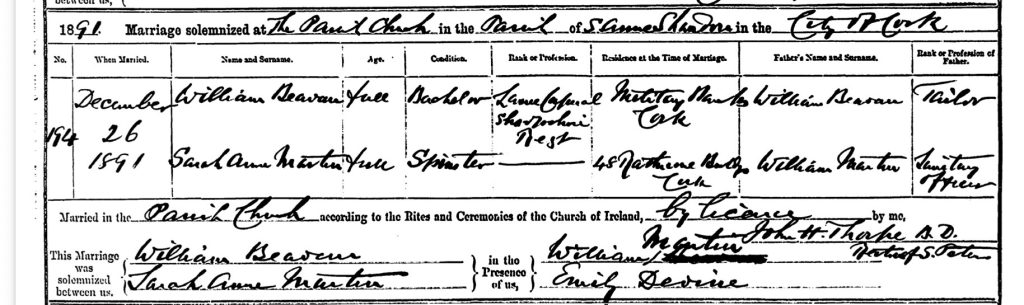
They lived in Cork for about nine or ten months, and then removed to London, where they stayed for some time. Subsequently they lived in barracks at Portland for about three years, and then on to Portsmouth. In 1899 Beavan headed to South Africa for the start of the Boer War after being stationed at Aldershot.
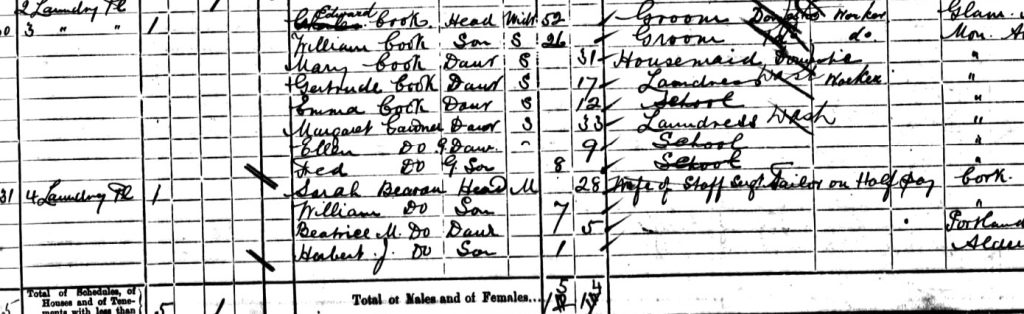
The family moved to Abergavenny where Beavan intended to set up business as a tailor on his return from South Africa. The census of 1901 states that Sarah Ann Beavan was living at 4 Laundry Place in Abergavenny with three children – William (aged 7), Beatrice (5) and Herbert (1). In the house next door live the Cooke family – the father Edward (52) is a widow and employed as a groom as is his oldest son William (26).
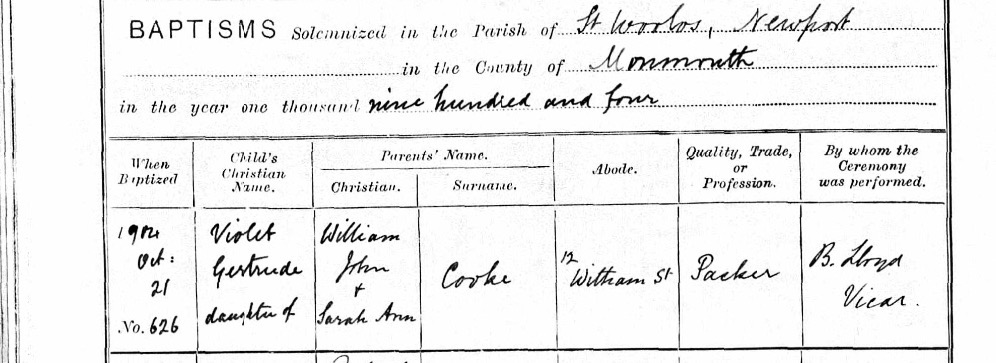
The relationship between Sarah Ann Beavan and the younger William Cooke clearly developed quickly. By 1902 they were living as a family at 12 Witham Street near Corporation Road in Newport. In addition to Sarah’s three children they had a further two – Gordon (born January 1903)and Violet (born 25 September 1904). William Cooke’s occupation is given as packer and by 1905 he was a bridge man with the Great Western Railway.

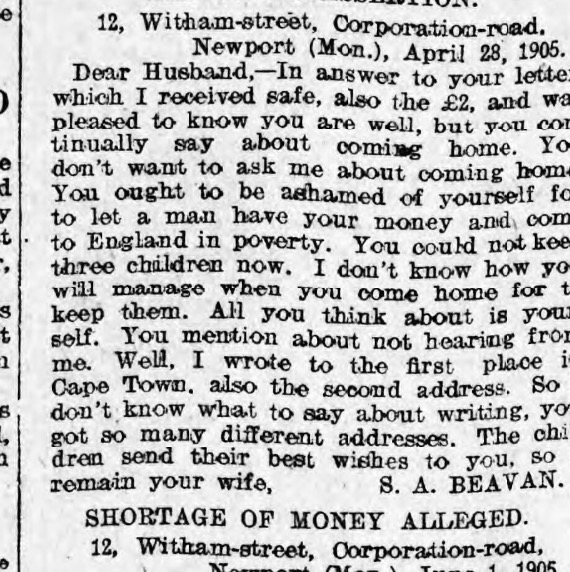
At the end of the Boer War in 1902 William Beavan stayed in South Africa setting up a tailor’s business and it appears he wanted to his wife and children to join him there. She refused but it appears had already chosen a new life with William Cooke. After six years away Beavan returned to find his wife had met another man.
From her point of view it is clear that she had no intention of going out to South Africa and had decided to move on given that he was set on living there and had last been home over six years ago. She was a young woman with three children to support, receiving limited support from her actual husband and found a man nearer to her age who she was evidently attracted to.
By 1905, six years after he had left her in the UK, he had found that she was living in Newport. There were letters between them where she clearly indicated her feelings
Having tracked his wife down to Newport he came back to the UK in September 1905 and stayed in accommodation attached to the London restaurant on Commercial Street.
He wanted to reunite with his wife but she refused his request. They met with their young son at his accommodation and this is where he meted out his retribution in the most horrific way
The crime is described in one newspaper as follows
WIFE MURDERED- A GHASTLY NEWPORT CRIME.
HUSBAND ARRESTED .
Story of a Double Life.
At the London Restaurant, Commercial Street, Newport, on Tuesday evening a man, named William Beavan, cut his wife’s throat, and she died with in a few minutes. Beavan suffered himself to be arrested. It was about half-past four that persons passing along Commercial-Street were informed at terrifying screams from a woman within the restaurant, and shouts of Murder were heard. About the first person to enter the house Mr Henry Gatehouse, builder, who became the witness of an astonishing scene. There had been staying at the restaurant a man of very respectable appearance and manner, named William Beavan. who is described as a master tailor, lately of the King’s Shropshire Light Infantry. He arrived at the house about three weeks ago, apparently from Africa.. and took a bed for a night or two. He remained there as a lodger until Tuesday. Whilst he had been away his wife had been living at Newport at 12, Witham Street, off Corporation Road. There will be no doubt that the parties had for some reason agreed to live apart upon his return to this country. But whatever may have been the circumstances, or whatever the decision at which they arrived, it did not debar them from having friendly relations at the London Restaurant. The wife had been there on several occasions during Beavan’s sojourn, and there seemed to be the best of feeling between them. What the immediate cause of the tragedy will not be known until the husband himself — now in custody on the capital charge—makes explanation.
The only persons who were in the room were the husband. William Beavan, his wife, Sarah Ann Beavan, and their little boy, Bertie Beavan. The little boy is under six years of age, and can give no account of any value of the terrible crime. It must have been a sudden outburst of feeling which swayed the man to the deed, as the parties had been together in the house for five or six hours, apparently on the most friendly and quiet terms. Then, at 4.30, came the most piercing shrieks of “Murder!” which not only startled the inmates of the house, but rent the air out in the street, and attracted the passers-by. The poor woman’s throat had been cut in the most desperate banner, the gash in the left side being over six inches long. She rushed downstairs from the third floor to the ground floor in the most frantic agony, and, though she was taken to the hospital in a cab as quickly as possible, surgical aid could not save her life. The great blood vessels were severed, and the windpipe had been cut into.
A GHASTLY SCENE.
It was a terrible wound, and must have inflicted with much force. One of the early witnesses of the poor woman’s agonised condition said it was a great gaping cut that he could thrust his hand into. As nearly as possible it was seven inches long, and extended from just below the hinge of the jaw to the front of the windpipe. From such a wound it can easily be imagined that the bleeding would be most profuse. Mr. Gatehouse, who was the first to render assistance, had his arms and his clothes saturated with blood, and the clothes on the bed, which stood in the husbands bedroom upstairs on the third floor, were also soaked in the murdered woman’s gore. The scene was made still more ghastly by the fact that the walls of the room in the corner nearer the door were badly splashed with blood. These splashes are low down, and seem to indicate that the victim stooped, apparently in her effort to avoid the attack. She died before reaching the hospital in a cab. The most material part of the story is that told by Mr. William Mattick, the manager of the London Restaurant, where the murder was committed. The London is a temperance house, which has attained a considerable custom in the town. It is pleasantly situated in one of the busiest centres, opposite the Commercial Street Baptist Church. There are four floors, and it was in a front bedroom on the third floor that the terrible crime took place.
RESTAURANTEUR’S STORY.
Mr. Mattick gave all the information in his possession. His story was as follows: — “The man who has been taken into custody came to the house about three weeks ago, and had a bedroom up on the third floor. The place suited him, and he stayed on until now. He was a most quiet, respectable man, well-dressed, of retiring habits and disposition— in fact, he was quite a gentleman inn his manner, speech, and appearance. Understand that he had been in the Army, and that he was also a tailor He came home from Africa, where he had been for six years, but whether he had come direct here on arrival do not know. I think it was so. “Did you know that he was married and had a wife staying at Newport?” “Not when he first came here,” Mr. Mattick replied “But I found afterwards that a woman called upon him here with her children, and I learnt that it was his wife. He ‘s said to be 40 years of age. He looks older than that. His wife was younger—by, I suppose about ten years or so. That was what have been informed. She had been living in Witham Street.” How often did she come here to visit him?..” Oh, twice or three times a week. Sometimes she would bring the children with her. There were, I understand, three children— two boys and a little girl. She would stay sometimes for a few hours, and sometimes she would only stay a few minutes, just for a short chat.” “But did you not think it strange that husband and wife should be living in that way—she in Witham Street (more than a mile and a half away) and he here, at the London Restaurant, and still be on visiting terms.” “They were living separate.” answered Mr. Mattick and it was no business of mine to inquire into their affairs – though I have heard some rumours.” “Was Beavan a steady man whilst he was here?” “Yes, very steady and quiet. If he took a drop of drink from outside the house he never became what I should call drunk, and he was always very quiet with it.” Had he any occupation whilst here “He had no occupation whilst he was” To come to what took place today, his wife came here for the first time this week to-day, and brought with her one of the children—the little boy Bertie who is bout six years old. They came about half past ten this morning, and spent the morning with Mr. Beavan quietly and comfortably. They had dinner in the dining-room behind the shop about half past one and then soon after two o’clock, the three of them went upstairs to the bedroom on the third floor as they a done on other occasions. I have seen them sitting there looking out of the windows and chatting. They seemed to be very friendly to-day. About half past four this afternoon I was in a bedroom at the back of the house on the third floor—the same floor as Mr. Beavan’s bedroom. The door to my room was closed, but Mr. Beavans was open. And at once, without a word or a sound of warning, I heard the most piercing screams from a woman of ‘Murder!’ I ran out, and saw Mrs. Beavan going down the stairs as fast as she could. I didn’t quite know what, had happened, but I could see a lot of blood about. Beavan was standing in the bedroom, in his shirt sleeves and without a collar on. I said to him, “What have you done?’ He replied, “I have cut her throat, and here is the razor.’ He handed me a razor covered with blood. I rushed down stairs after the woman to fetch a doctor as fast as I could. I ran down Commercial Street, and brought up Dr. Buckner, but by the time he came they had got the woman out of the house and put her into a cab to take her to the hospital. So Dr. Buckner did nothing.” You say that you heard no sounds at all before you heard the screams—no quarrelling or shuffling of feet?” Nothing whatever. Everything was as quiet as could be I cannot understand that there was any quarrel at all. I heard nothing until the scream. He handed me the razor, and I didn’t know what became of him at the time. The little boy ran downstairs screaming.” He had no coat or collar on when you went to the room. Was he fully dressed when they went upstairs after dinner?” Yes, be was fully dressed then. Whether he had taken his coat and collar off to have a doze in the afternoon I do not know. I handed the razor over to the police. Mrs. Beavan did not speak to me.”
I SHALL NEVER HANG
As an additional note in his evidence to the Police Court hearing following the arrest and charge of Beavan the latter is reputed to have said “I am the man. I done it with a razor. I shall never hang. She is a _” it is stated that he did not finish the sentence.
The initial Police Court hearing
The initial Police Court hearing on September 20 followed Beavan’s arrest at the scene of the crime. It was notable for the huge amount of public interest.
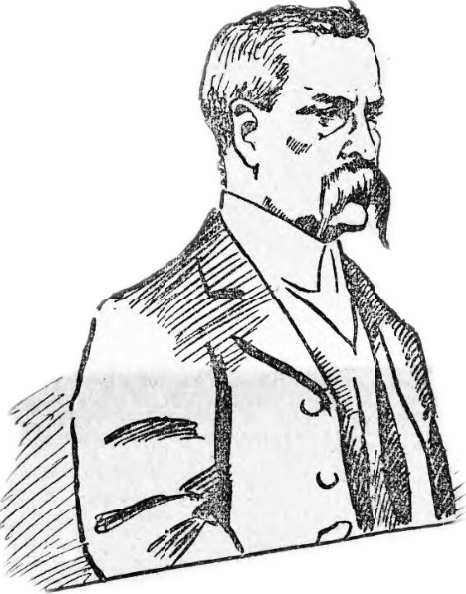
The Evening Express described William Beavan sympathetically as follows “When the accused was arraigned in the dock he presented a rather dejected appearance . He was, however, clean and well- groomed. His long moustache was nicely curled down to fine points, his beard was trim and orderly, and his whole appearance was one of considerable care in the master of attire. He wore a light grey suit, a grey frock coat, and a pilot cloth overcoat above it. As he stood in the dock hie hands nervously clutched the front. rail, and he looked down- cast during the whole time the proceedings were on.”
Coroner’s inquest and police court hearing
The Coroner’s inquest into Sarah Beavan’s death took place on the Monday after her death (on 25 September 1905). In the Western Mail Beavan physical appearance at the hearing is described as ‘clean and slick and span’ listening attentively to the evidence. The inference being, again, that he is respectable and respectful man.
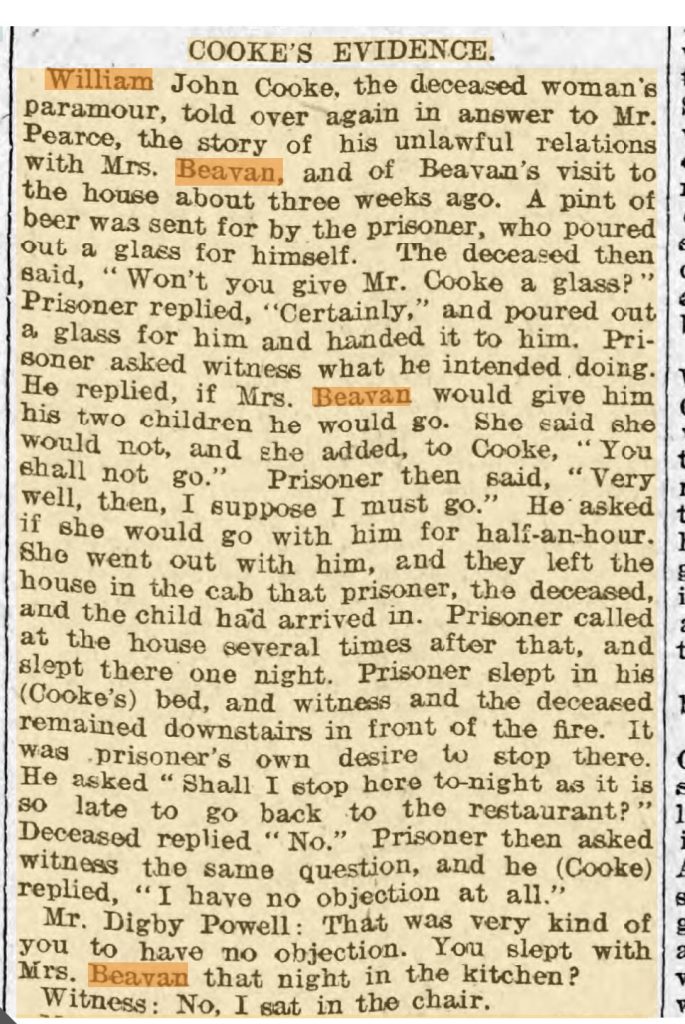
William Cooke was called as the first witness. The coroner Lyndon Moore said the purpose of the inquest was to establish the cause of death and not to examine the morals of Mr Cooke’s relationship with Mrs Beavan. However, he allowed Beavan’s legal counsel to ask questions about their relationship and how it came about. Cooke explained he had been a soldier in South Africa and returned in 1900 when he first met Mrs Beavan in Abergavenny. It was not until 1903 that she came to live with him at Witham Street. He said he was unaware that Beavan wanted his wife to go to South Africa or that he had given her money whilst living with him in Newport.
The Coroner concluded that there were arguments to consider on both sides but he did not propose to ‘sermonise’. The jury returned a verdict of wilful murder against Beavan. It is said his relatives ‘sobbed’ as the verdict was returned.
The following day a procedural Police Court hearing examined witness evidence prior to the main trial. Cooke was called again and recalled how he and William Beavan met at the house in Witham Street. Cooke claims Beavan brought him a beer and they discussed what would happen. He said he was prepared to leave but Sarah had insisted he stay. He allowed William Beavan to stay at the house overnight as it was late.
The case was committed for trial at the Monmouthshire Assizes. Due to the public interest Beavan was moved from police cells to prison in Usk by special carriage to avoid potential demonstrations. The newspapers noted that the Rev Elwyn Thomas had visited Beavan and found him ‘reverential’ , intelligent and well spoken, seeking God’s forgiveness.
SARAH’S FUNERAL
In the same period the newspapers mark Sarah’s funeral and burial. The procession went from the hospital on Cardiff Road to St Woolos cemetery. It noted that the ‘awkward question’ of who should pay for the funeral was settled by Digby Powell, Beavan’s solicitor, who stated the prisoner would stand the cost. Cooke had no part in it, it states.
Reports state ‘thousands’ of people congregated the route but that no one present was a relative of Sarah or either of the men. It states police and funeral bearers carried the coffin and there were no flowers.
The Western Mail notes that Cooke stayed away“ It was well that he did so, for the expressions of opinion, both on the way to the cemetery and in the Necropolis itself, were entirely in favour of the accused man and against Cooke. “
The officiating clergyman the Rev Gower Jones committed her to burial, putting the final nail in her coffin, as follows “We silently commit her body to the tomb, praying that in spite of her Sins she may find mercy in the great day of judgment.”
It seems driven by the newspapers the court of public opinion was heading in only one direction. Sarah’s circumstances were completely ignored and the focus, even at her funeral, was on the unfair treatment of her murderous husband.
The trial
The press reports of the trial at the Monmouthshire Assizes state that a considerable crowd was present to watch the trial and the Evening Express claimed ‘overwhelming public sympathy’ for William Beavan. For the first time Beavan gave evidence. Without his wife to contradict him he claimed that he arrived in Newport on August 29. He claimed she had met him from the Portsmouth train and informed him she had got into trouble and took him to lodging at the London restaurant. He claimed he was unaware until that point that she was living with another man. It is claimed he was crying at certain points in his testimony. He says he repeatedly asked for her to go back to him but she refused.
He was questioned by the Crown about his correspondence with his wife including a statement In one letter he told her he would not be surprised to find the police waiting for him when he reached England, but he could not give a reason for making such a statement.
He still declared that he was not aware of his wife’s unfaithfulness, although this claim looked unlikely when he admitted that he received a letter from his wife which contained an explanation of her position. In one of these letters his wife told him that he did not suffer much, and that she and the children had got on during his six years’ absence and later stated to him that Cooke was as much a husband as he had been. In another letter Beavan referred to his ‘fast life before marriage, I know I have wronged you and the children’ but under questioning could not explain what it meant.
Although the charge of murder potentially carried the death penalty it was suggested by the Judge to the jury this could be commuted to manslaughter if they found the crime was carried out in the heat of passion.
The Evening Express report states “When the foreman of the jury said they found the prisoner guilty of man- slaughter prisoner put his hands together as if in prayer. He had nothing to say to the court. Addressing him, the Judge said: “The jury have found themselves able to take the less serious view of the terrible crime which you have committed. It was an awful and cruel crime. The sentence cf the court is penal servitude for life.” Prisoner staggered at the sentence, and was then quietly removed below.”
Appeal for clemency
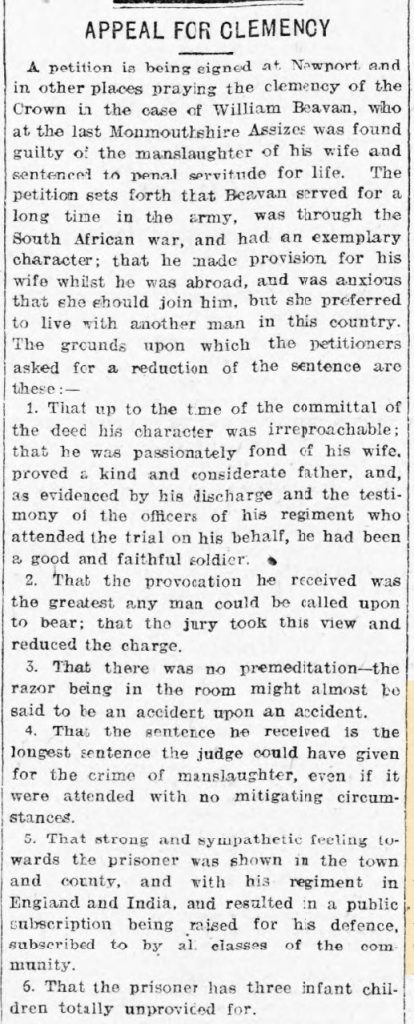
A remarkable appeal for clemency followed with a petition promoted by Digby Powell just before Christmas 1905. This sought to minimise the crime as an ‘accident upon an accident’ with no premeditation. It laid great store on Beavan’s service and military background, overlooking the horror of his crime and the fate of his victim.
Nevertheless it garnered 30,000 signatures and was submitted to the Home Secretary (Herbert Gladstone). It fell on deaf ears.
In 1910, an appeal was made to King George V on his accession to the throne. Weeks later, the Home Secretary (Herbert Gladstone) recommended that Mr Beavan be released after 7.5 years.
What became of Beavan and Cooke?
Beavan’s children went to live with his brother, a coal miner. Following his release according to the 1921 census William Beavan is living in Clifton, Bristol as a tailor. In March 1924 he died aged 58.
William John Cooke started a new life, marrying Annie Davies in 1907. They lived at 1 Archibald Street, Maindee with his two children from his relationship with Sarah Ann Beavan and children from his new marriage. He was employed as a GWR bridge man until retirement and died in 1940.
Conclusion
It was a different era with different codes and ethics but this remarkable story reveals the power of public presentation. A wave of public sympathy followed the kindly press description of William Beavan’s character, an individual of impeccable military background, driven to commit a heinous crime due to his wife’s ‘unlawful’ behaviour. No concession is made for the fact he was absent for over six years and his wife fell in love with a man closer to her own age and informed him of the situation. The crime is deemed to be almost an accident, with an all too accessible razor nearby. No account is taken either of the presence of their six year old son at the murder! It’s all forgiven as he was a good man. So much so that following the manslaughter verdict calls for public clemency achieved a significant reduction in the sentence.