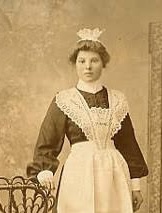
Infanticide was a significant social crisis in Victorian England, peaking in the 1860s, driven primarily by economic desperation, extreme poverty, and the intense social stigma surrounding illegitimate births. Unmarried mothers, often domestic servants, faced limited options, leading many to abandon or kill newborns, frequently aided by “baby-farming” practices. Beyond poverty, the 1834 New Poor Law, which removed fathers’ financial responsibility for illegitimate children, significantly increased cases. The cases almost exclusively involved young women of very limited means and their actions were associated with insanity.
While killing a newborn was legally murder leading potentially to the death penalty juries were often lenient, frequently reducing charges to concealment of birth due to sympathy for the mother’s circumstances.
We look at the story of one young woman who came from rural Wiltshire to Newport. Rose or Rosanna Snelgrove was born in Colerne in Wiltshire in 1879.
Rose’s father, William Nash Snelgrove, died in 1886 at the age of 55. Her mother, Jane Ford, who was fifteen years younger than him, later remarried, taking the surname Curtis. By the time of the 1891 census, Rose was living in Warminster with her mother and stepfather. She was thirteen years old, and her occupation was recorded as working in the town’s silk factory.
In late 1895, Rose moved to Newport. By then she was already five or six months pregnant, and it is presumed that the child’s father was from the Warminster area. Her departure from her home town appears to have been an attempt to escape the shame attached to her condition and, in some way, to conceal the birth. She must have been frightened and desperate.
This is not to excuse the death of a child in any way, but it is important to recognise that women like Rose were often placed in impossible situations, with few options and little support.
A SHOCKING DISCOVERY
The Cardiff Times reported a shocking discovery on Thursday 12 March 1896 at the home of Mr W. A. Linton, master builder, 75 Caerleon Road, Newport. A young domestic servant, Rose Snelgrove, who had been in the household’s employ for several months, was suspected by her mistress of being pregnant, though she repeatedly denied it.
On the Thursday afternoon, while Mrs Linton was briefly out of the house, the girl became ill and distressed. On her return, Mrs Linton searched the coal cellar and found a bloodstained hatchet and, in a tub in the corner, the body of a newly born female child. The infant had suffered severe head injuries, including a fractured skull. Although it is never clearly stated presumably the hatchet was used to cut the child’s umbilical cord.
A doctor was summoned and the police were informed. Due to her condition, the girl could not be removed from the house and was placed under police supervision. She had been taken ill earlier in the day and had continued to deny having given birth.
The report said “Rose Snelgrove aged about 20 was a native of Warminster, Wiltshire, and had been in service at the house for around five months. She was described as industrious and well-conducted. “
The child’s body was removed for post-mortem examination, and an inquest was expected to be opened shortly.
On 18 March Rose was admitted to Newport Workhouse (Woolaston House).
The Cardiff Times reported the following on 28 March “The adjourned inquest into the death of a newly born female child of Rose Sudgrove, an 18-year-old domestic servant formerly employed by Mr W. A. Linton of Caerleon Road, Newport, was held at the Town Hall on Monday before the borough coroner. Evidence showed that the girl, formerly a silk factory worker in Warminster, had been in domestic service for three months and had consistently denied being pregnant. During a short absence of her mistress on the day she was taken ill, the birth occurred, and the child’s body was later found concealed in the coal cellar. As no one was present at the time, it was suggested that the girl may have been in a delirious condition.”
Following a verdict of suspicious circumstances from the coroner the matter was referred to the Police Court. The workhouse register records Rose as being re-admitted to Woolaston House.
CHARGED
Rose Snelgrove was charged at Newport Police Court on 8 April with the wilful murder of her newly born female child at her employer’s home in Caerleon Road on 12 March.
Evidence presented by the prosecution stated that the child was fully developed, born alive, and died from a severe head wound consistent with being inflicted by a sharp instrument. Medical witnesses supported the view that death was caused by the fracture of the skull.
The defence argued that the child died shortly after birth and that the injuries occurred after death, while the girl was in a state of extreme physical and mental distress. Her defence lawyer Mr F Davies said “It was the old story of the woman being left to bear the burden, while the man who had betrayed her could not be brought within the reach of the law. “ He urged the Bench not to commit the prisoner to take her trial on the capital charge.
When cautioned Rose by the lead magistrate Alderman Phillips she did not speak. In fact there is no record of her making any statement in the reporting of her court proceedings.
After considering the evidence, the magistrates committed Snelgrove for trial on a charge of wilful murder, a capital offence, with the case to be heard in July.
Several of the jurors returned their fees towards the defence of Rose. In fact the case became a cause celebre for several locals. A Mr Charles Ayliffe of York Place in Newport wrote to the Echo stating he had collected £14 or £15 on the streets of Cardiff to support Rose and contribute to her defence. He wrote “Having been earnestly appealed to on behalf of the girl Rose Snelgrove charged with the above crime, to provide legal help at her trial, I shall be glad to receive any sum, however small, for this purpose.”
THE TRIAL
On 8 July Rose was tried at the Monmouthshire Assizes in Monmouth before Mr Justice Hawkins and a jury of her peers. She pleaded not guilty. For an 18 year old young woman this must have been a highly daunting experience but fortunately the proceedings were sympathetic to her cause.
The prosecution, with the court’s approval, abandoned the charge of murder and proceeded instead on the lesser issue of concealment of birth, citing insufficient evidence that the child was born alive. Evidence was heard regarding the discovery of the infant’s body in a cask at her employer’s house during a brief period when she was alone.
After reviewing the evidence, the judge agreed that the murder charge could not be sustained. The jury returned a verdict of not guilty in relation to birth concealment and Rose was discharged.
The Workhouse Register records that Rose was acquitted on 8 July. It does not say where she went and my search of newspapers and genealogy records has yet to find her whereabouts. She could have returned to Wiltshire or moved elsewhere. After all her escape to Newport was obviously to hide the pregnancy from her locality and maybe even her family. Presumably she had some financial support at her trial and may have had emotional support too but there is no indication of what became of her after this traumatic event in her life.