Lloyd George found Monmouthshire an unresponsive area complaining in a letter to his wife during the campaign for home rule of 1895 “the sad folk of Tredegar seem permanently sunk in a morbid footballism”. He felt that the working classes were more interested in rugby than his crusade for home rule.
He used the phrase to criticise what he viewed as an unhealthy, excessive obsession with football—specifically rugby—in South Wales. It was not just Tredegar it was all over the area including Newport.
Rugby football experienced a meteoric rise in the 1900’s. This period is recognised as the first “golden era” of Welsh rugby (1900-1911), marked by unprecedented international success, the development of a unique playing style, and the sport’s adoption by the working-class. The Welsh team won the Home Nations on six occasions, achieving three Grand Slams and beat the All Blacks in 1905. The match marked the first rendition of ‘Hen Wlad fy Nhadau’ as the National Anthem.
Newport Rugby Football Club was among the strongest in the land with one of the most demanding fixture lists regularly attracting large attendances.
The popularity of the game fed it its way into a proliferation of local clubs and league structures. In Newport most districts, associations and villages had a rugby team. In 1912 Newport RFC had three teams, Pill Harriers two, there were teams at Newport Crusaders, Corinthians, St.Woolos, St. Michael’s, St Stephen’s, Caerau, Commercial Road Methodists, the Catholic Institute and the Docks as well as in the south Monmouthshire villages such as Goldcliff, Sudbrook, Redwick and Caldicot. Newport was surrounded by many junior teams in the valleys and to the east.
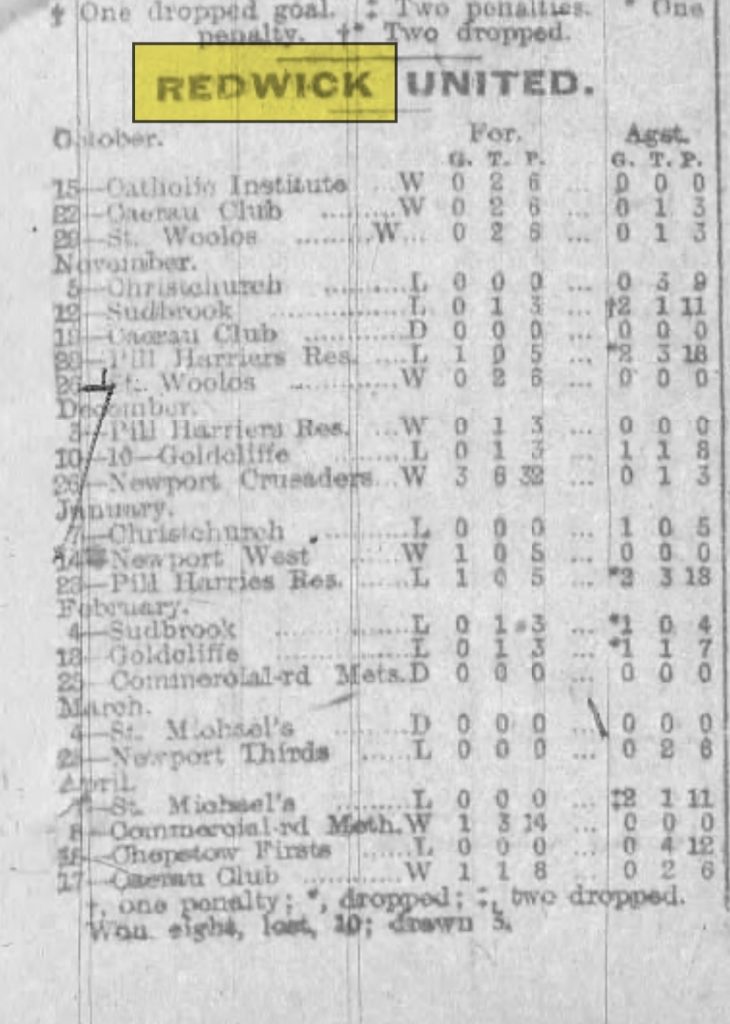
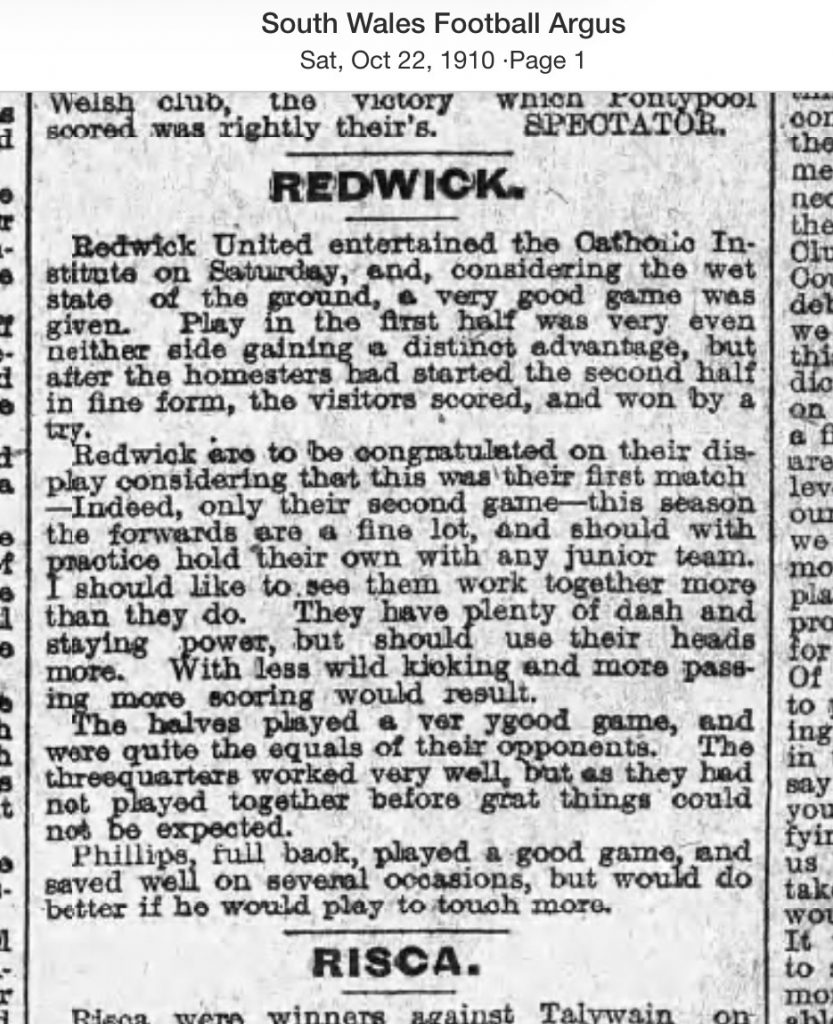
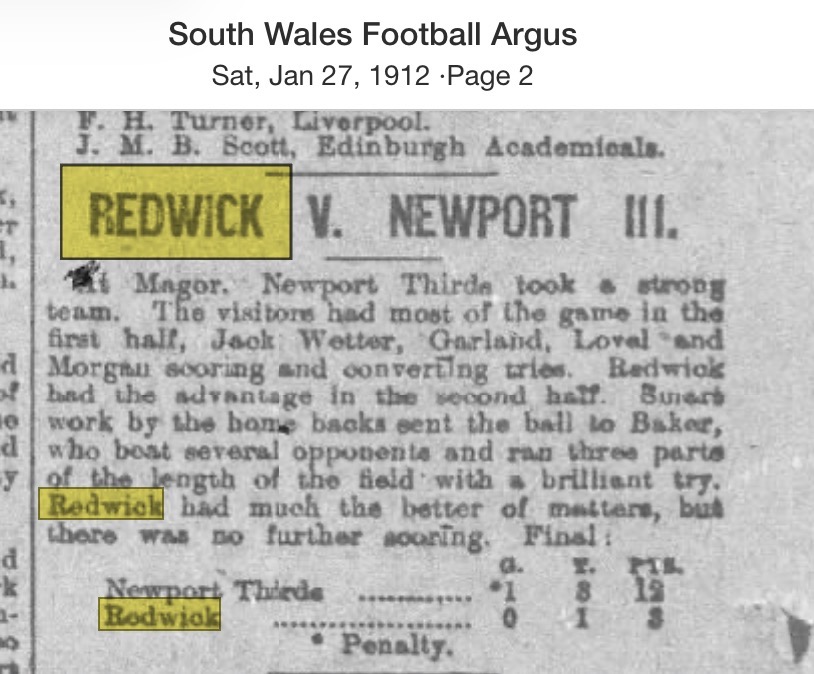
Our focus is on Redwick, a village to the south of Newport on the Levels with a population of little more than 250 in 1911. Remarkably this village sustained two rugby teams for a season, Redwick United and Redwick Rovers, with players drawn from surrounding localities such as Magor and Bishton. In October 1910 Redwick United played their first match against the Catholic Institute. The venue is not known but after this the team played 21 matches recording eight wins, three draws and ten losses. 1911-12 saw the amalgamation of Magor and Redwick United and the formation of a separate Redwick Rovers team. United played some significant fixtures including a match against Newport Thirds led by Jack Wetter. By now it seems that the United club were playing their matches at Barecroft Common near to Llandevenny. Redwick Rovers were a separate team and called on many of the former Redwick United players. They competed in the newly formed Magor and District League. Many of the players were local farmers but some went on to greater rugby prominence playing for major clubs such as Newport.
By 1913-14 Magor and Redwick United and Redwick Rovers had amalgamated into one team with many of the old Redwick management took key positions.
The interruption of the First World War and the huge impact on the male population led to a reduction in teams after the end of the conflict. There is no record of a Redwick team, for example, after the war.
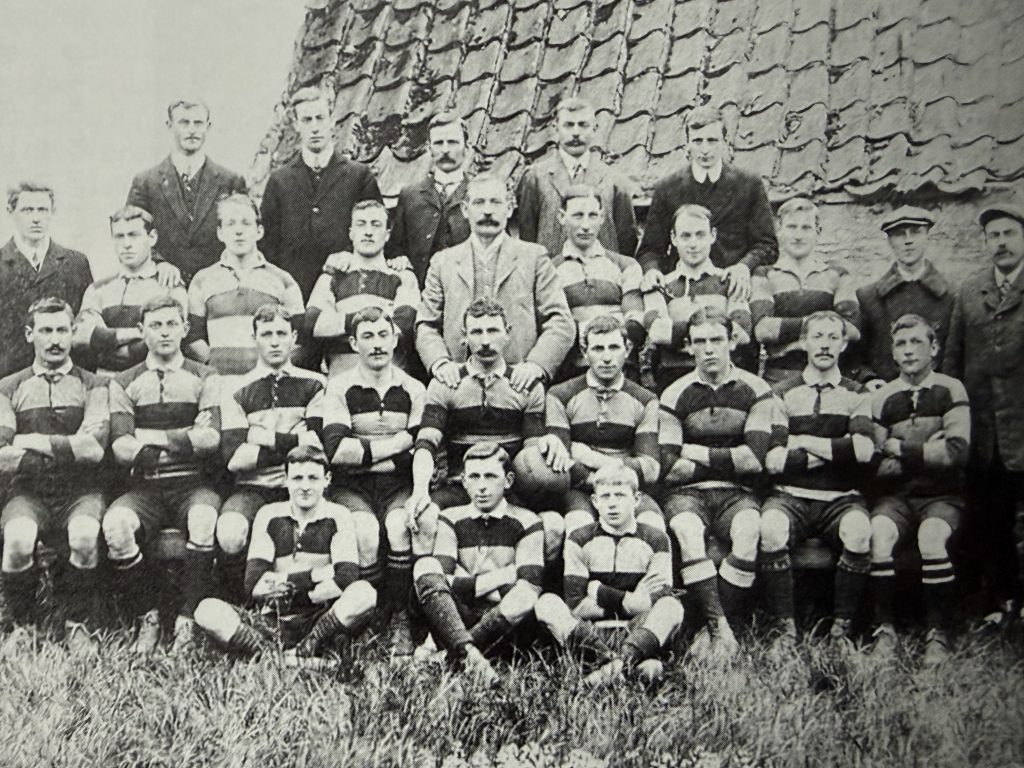
Line up – back row – W Jones, J Cox, J Lewis, R Payne, C P Burris (Hon Secretary)
Third row – H Wellington, S Potter, H G Tucker, S Cochrane, W E Baker (President), T L Stead, G H Baker, J Waters, Dr Vaughan, A R Baker
Second row – H Reese, G Harris, E C Cochrane, J Payne (Vice Captain), J C Reese (Captain), S Reese, T D Pritchard, F Payne, S G Brace,
Front row – S Cochrane, H Phillips, A Phillips
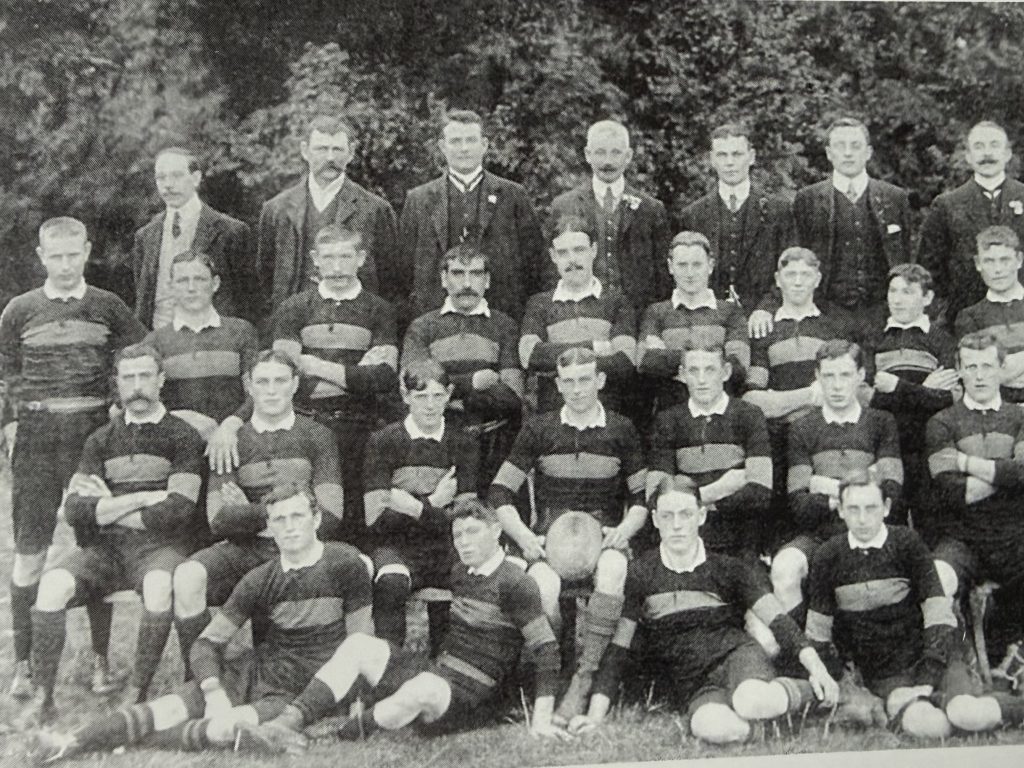
SOME OF THE PLAYERS AND ADMINISTRATORS
Edgar Charles Cochrane – b 16 April 1889 South Row Redwick (father John – labourer, mother – Caroline). On the 1901 census he was recorded as living in the hamlet of Summerleaze, adjacent to Redwick. At the time of the picture in 1911 he is living with his mum, dad and four other brothers near the Cross in Redwick, aged 22, employed as a hay cutter. By 1921 he is living at Grange Cottage, Llandevenny employed as a hay trusser employed by Mr J Hugget living with his wife, Sarah and 7 month old daughter Phyllis (he and Sarah married in March 1920). He died in December 1981 aged 92.
Sidney(Sydney) Cochrane b 20 December 1887, brother of Edgar and Samuel (also pictured). In 1911 he is living with his in laws and wife Edith at Barecroft Common in Magor near to the rugby ground! He married Edith in the summer of 1910. He is employed as a hay cutter. In 1939 aged 52 he is a farmer at Fairfield in Whitewall between Redwick and Magor living with his wife. He died in 1966 aged 79.
Samuel Cochrane b 11 December 1891 Summerleaze. At the time of the picture in 1911 he is living with his mum, dad and four other brothers near the Cross in Redwick, aged 20, employed as a hay cutter. Married Gwendoline Lewis in 1915.
In 1921 they were both running the Kings Head public house in Redwick along with their young family. By 1939 they are living at Castle Cottage in Bishton working as a ‘Council Roadman’ He died in 1982 aged 90.
Frederick Cochrane – Bleak House, Summerleaze in 1939. Father of Bill Cochrane who ran a mobile shop locally in the 1970’s. Presumably Bleak House became Dale House.
James Reese – Captain. Born Langstone 1875. Listed on 1901 as farmer’s son living at Church Farm, Llanmartin with his mum and dad (John and Sarah). He has eight brothers (including Harry and Samuel) and five sisters. By 1905 he is living with his wife Sarah at Summerleaze Farm. They are still there in 1921. On 11 November 1926 he died at Lord Ninian Nursing Home in Cardiff aged just 51.
Henry (Harry) Reese – born Langstone 3 April 1881. For 1911 see above, he is in Llanmartin. By 1921 he is still at the family farm as head of household with his wife Edith May. They are still there in 1939. He died in April 1968 aged 87.
Samuel Reese – born Langstone 6 September 1885. From 1921 he is head of household at Coldra Farm, Christchurch with wife Gladys and four children. By 1939 he is at Llandevand Farm Llanmartin. Died Llandevaud Farm 1973, aged 87.
Reginald Payne – born Redwick 8 December 1883. He was a farmer living at the Grove in Goldcliff.
Frederick Arthur Payne – b 12 January 1881. Living at Church Farm, Redwick in 1911 as a farmer with his parents Alfred, a railway guard, mother Annie, and sister Clara. He did not marry until 26 Dec 1922 when he was 42 to Florence May Eddy in Bishton. She was a US citizen from Oregon. He died in 1953.
President – William Edgar Baker b Redwick February 14 1865 grew up on Longlands Farm in Redwick (parents Thomas / Blanch). Moved to Llandegveth area in 1891 with wife Selina and family returning to Redwick in 1904 to take over the family farm. He was a Justice of the Peace. She died in 1926. He married again, to Mary Jane Baker in January 1928. He died on 15 September 1940.